Lab Testing of Himalayan Treasures : Yarsagumba, Shilajit and so on
The high mountains of the Himalayas hide some of the world’s most valuable natural products: Yarsagumba, shilajit, morel mushrooms and many rare herbs. They’re called “mountain gold” for a reason – a single kilo can be worth lakhs or even more in export markets.
But exactly because they are so expensive, buyers worry about fake products, contamination and inconsistent quality. That’s where lab testing becomes your best friend – whether you’re a collector, trader, farmer group, or a brand trying to sell in Nepal or abroad.
This blog walks you through how lab testing is done, what is measured, what standards matter, and where you can have these products tested, especially from a Himalayan/Nepali context.
Why Lab Testing Matters for Himalayan Products
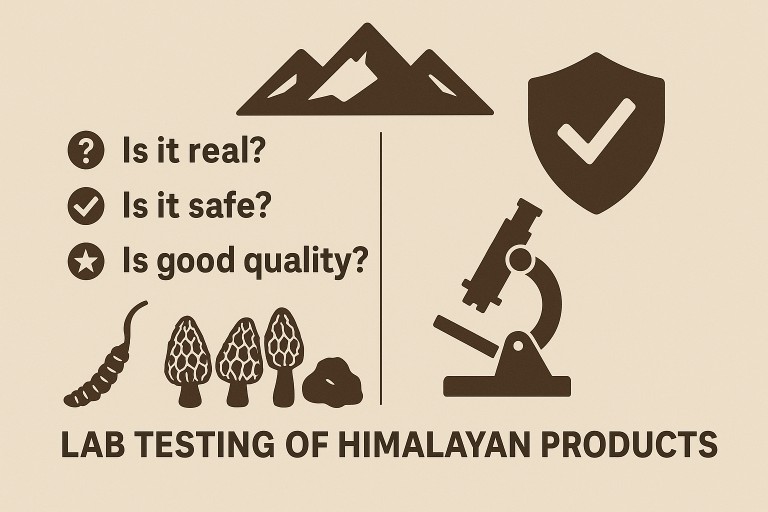
Before talking about machines and methods, it helps to know what we’re trying to prove with testing. For high-value Himalayan products, labs basically answer three big questions:
Is it real?
Is this genuine Yarsagumba or shilajit, or a fake/adulterated version?Is it safe?
Does it have safe levels of heavy metals, microbes, pesticides, and toxins?Is it good quality?
Does it have enough active components (like cordycepin in Yarsagumba or fulvic acid in shilajit) to justify the price?
Most lab reports will be some combination of identity tests, active compounds, and contaminant checks.
What Labs Usually Measure (Common for Many Products)
Regardless of the specific product, most tests fall into these groups:
Identity & authenticity
Visual & microscopic examination
Chemical “fingerprints” (like UV, FTIR)
DNA barcoding for very high-value or disputed materials
Active/quality markers
Specific compounds that show quality (e.g. cordycepin, fulvic acid)
General composition: moisture, ash, protein, oil, etc.
Safety & contaminants
Heavy metals: lead (Pb), cadmium (Cd), arsenic (As), mercury (Hg)
Microbiological: total plate count, moulds/yeasts, E. coli, Salmonella, etc.
Pesticide residues
Mycotoxins (toxins produced by fungi, especially in dried products)
Physical parameters
Moisture content
Foreign matter (soil, stones, insects)
Cleanliness and overall appearance
Now, let’s see how this plays out for specific Himalayan treasures.
Yarsagumba: Proving the “Mountain Gold” Is Real & Safe
Yarsagumba (often sold as Cordyceps) is both biologically unique and very expensive, so fraud is a big issue.
How it’s tested
1. Identity & authenticity
Macroscopic & microscopic checks
Experts check the insect body and fungal part, pores, colour, and structure.DNA barcoding
For high-value export, labs can sequence a standard DNA region (like ITS) to confirm it’s actually Ophiocordyceps sinensis and not a cheaper species.
2. Quality markers
Usually measured with HPLC or LC–MS:
Cordycepin
Adenosine
Polysaccharides and other key compounds
Moisture & total ash to ensure it’s properly dried and not mixed with soil
3. Safety checks
Heavy metals: especially arsenic, lead, cadmium, mercury
Microbial load: no dangerous pathogens; limited total bacteria and mould
Pesticides & mycotoxins: depending on where and how it was stored/handled
For serious buyers and international markets, a yarsagumba batch without a good lab report is increasingly seen as too risky.
Shilajit: Fulvic Acid, Heavy Metals & Fake Resin
Shilajit is another classic Himalayan product that has become popular worldwide as a health supplement—and also very heavily faked.
How it’s tested
1. Identity & authenticity
Visual and simple physical checks (colour, consistency, solubility)
Spectroscopic fingerprint using UV–Vis, FTIR etc., to match the pattern of genuine shilajit
Comparison with pharmacopeia standards or validated in-house standards
2. Active content
Many buyers and brands focus on:
Fulvic acid percentage – usually determined by titration or spectrophotometric methods
Total humic substances
pH, ash, moisture
Labels often claim a minimum % of fulvic acid. Testing confirms whether that claim is actually true.
3. Safety checks
Heavy metals: shilajit comes from mineral-rich environments, so this is critical
Microbiology: ensure it’s safe as a consumable (no E. coli, Salmonella, etc.)
Adulterants: make sure it’s not mixed with tar, bitumen, added metals, steroids or synthetic chemicals
If you want to build a serious shilajit brand, a clean, repeatable lab profile becomes your strongest marketing weapon.
Morel Mushrooms (Morchella) & Other Wild Mushrooms
Dried morels from Himalayan forests are a premium export product. Because mushrooms can absorb pollutants and metals from the environment, testing is very important.
How they’re tested
1. Basic quality
Moisture content in dried mushrooms
Ash, protein, fibre, fat
Visual grading: size, symmetry, clean caps, minimal foreign matter
2. Safety & contaminants
Heavy metals: especially lead, cadmium, mercury, arsenic
Mycotoxins: aflatoxins and ochratoxin (important for dried foods)
Microbial contamination: to check if drying and storage were hygienic
Some food authorities also expect clear cooking instructions, because even edible morels can cause issues if not properly cooked.
Other High-Value Himalayan Herbs & Products
The same testing logic applies to many other Himalayan products, like:
Jatamansi, Kutki, Chiraito, Timur, Sugandhawa, Rhododendron flowers
Wild berries & sea buckthorn
Honey, ghee, herbal teas & spice mixes
For these, labs usually do:
Botanical identification (macro/micro, sometimes DNA)
Marker compounds (essential oils, alkaloids, glycosides, phenolics, etc.)
Contaminants (heavy metals, pesticides, mycotoxins, microbes)
Physical quality (moisture, ash, foreign matter)
If you’re building a product line, it’s smart to create a standard test panel per product and repeat it for every batch.
What Standards Do Labs Follow?
Most lab testing for Himalayan products is guided by a mix of:
National food & herbal standards of the producing country
In Nepal, that means the Department of Food Technology and Quality Control (DFTQC) and any herbal/ayurvedic regulations.
Importing-country rules
EU, US, India, etc. have specific limits for heavy metals, mycotoxins and pesticides in herbs, spices and dietary supplements.
Pharmacopoeias
Ayurvedic, Chinese, Indian, European or US pharmacopeias often have monographs (reference methods and limits) for certain herbs and ingredients.
General international guidance
WHO guidelines on quality control of medicinal plants
Codex standards for contaminants in foods
As an exporter, a good rule of thumb is: aim to meet the strictest relevant standard you can practically afford. That usually keeps you safe for multiple markets.
Where Can This Testing Be Done? (Especially for Nepal & Region)
If you’re operating in or near the Himalayas, you typically have three routes:
1. Government / Semi-Government Labs
National food and drug quality labs (like DFTQC in Nepal)
Can test: heavy metals, basic microbiology, aflatoxins, some pesticides, general composition
These labs are good for regulatory compliance and basic safety assurance.
2. Private Accredited Labs
ISO 17025 / NABL-accredited laboratories in Nepal, India and other neighbouring countries
Offer more advanced tests:
DNA barcoding
Detailed HPLC/LC-MS profiles
Wide pesticide residue panels
Mycotoxin suites, solvent residues, etc.
These are often used when exporting to EU/US markets or working with big international buyers.
3. University & Research Labs
Universities and research institutes can help with:
Identity studies
Pilot phytochemical screening
Collaborative R&D
They’re excellent for developing new products, though for commercial batches you’ll still need formal accredited lab reports.
A Simple Testing Workflow for Traders & Entrepreneurs
If you’re thinking, “Okay, but how do I start?” here’s a practical 5-step flow:
Pick your first hero product
For example: shilajit, yarsagumba or morel mushrooms.Check target market requirements
Are you selling locally, or exporting to EU/US/India? Collect the relevant safety limits and lab requirements.Make a test checklist for that product
Identity (visual + advanced method if needed)
2–3 key active markers
Heavy metal panel
Microbial tests
Pesticides / mycotoxins (if relevant)
Contact 2–3 labs and ask for quotes
Ask them:What tests they can do on that product
Their certifications (ISO 17025, national approvals)
Sample quantity, price and report time
Test every batch and file the reports
Give each batch a unique code, and keep its lab report safely.
You can even share select parameters in your product descriptions or brochures to build trust with buyers.
Conclusion: Lab Reports as Your Competitive Edge
For Himalayan products like yarsagumba, shilajit and morels, stories and tradition are valuable—but lab data is what closes deals, especially with serious buyers.
Lab testing proves your product is authentic, safe, and worth the premium price.
It protects you from accusations of adulteration and gives you confidence when talking to wholesalers, retailers and international partners.
Over time, a consistent lab profile can become part of your brand identity: “We test every batch, and we can show you.”
If you tell me which specific product you want to start with and which country you aim to sell to first, I can help you draft a ready-made test panel you can send directly to a lab as your “standard testing request.”